


Takeaways
- A corporate DJ has to read the room and keep adjusting the energy. In a club, almost everyone shares the same goal, which is to dance. A corporate event brings together people of different ages, tastes and roles, so the DJ has to adapt repertoire, pace and volume to each phase of the day, from the walk-in through the breaks to the closing party.
- A corporate event calls for a far wider repertoire than a club set. Timeless classics, international hits, contemporary tracks and background instrumentals all have to coexist within the same program, with close attention to the professional setting and to the need to support conversation rather than compete with speeches, networking and the other moments on the schedule.
- The DJ is one piece of a larger production and has to stay in step with every other element of the show. Corporate videos, speeches, product reveals, live performances and musical moments all call for precise entrances, transitions and restarts. That is why a corporate DJ needs to work comfortably alongside technicians, show directors and planners, making the music consistent with the brand’s story and its goals.
At corporate events the music has to work for mixed audiences, for shifting moments and for a run of show that includes speeches, networking and brand content
You may have found yourself at a convention where the music sounded like a Saturday night at a nightclub.
The DJ pushes the volume at exactly the wrong moment, picks a track that has nothing to do with the occasion and pays no attention at all to the formally dressed audience seated in front of them. It happens more often than you would think.
We heard about a convention in Milan roughly a year ago where the DJ dropped a bass-heavy house track, completely out of place, just as the CEO was about to take the stage. The applause was buried under the music, and the room endured a full minute of shared embarrassment before someone stepped in to fix it.
The reason for slips like this is simple: bringing a club DJ to a corporate event is like asking a Formula 1 driver to handle a tour bus. The technical skill may well be there, but the job itself is a different one.
Read also: Goals first, wow factor second: how to design a corporate event people remember
A different craft: a different repertoire, a different instinct
A club DJ works from one clear principle: build rising energy for a floor that wants to dance late into the night. The crowd is there for exactly that, has paid for a ticket and knows how the night works.
A corporate event DJ faces something else entirely. The audience is mixed in age and in musical taste, and even when the occasion is meant to feel relaxed, it is still a professional setting. Managers in their sixties sit beside interns in their twenties, international clients sit next to longtime suppliers, and some guests want to dance while others want nothing more than a quiet conversation and a drink in hand.
Handling that range takes a broad repertoire and a fine instinct for reading the room. A corporate DJ moves from a soul classic to a contemporary pop hit, from an eighties favorite to an instrumental background piece, calibrating volume and pace to where the evening stands at that moment. This ability to keep adjusting is the heart of the role, far more than pure mixing technique.
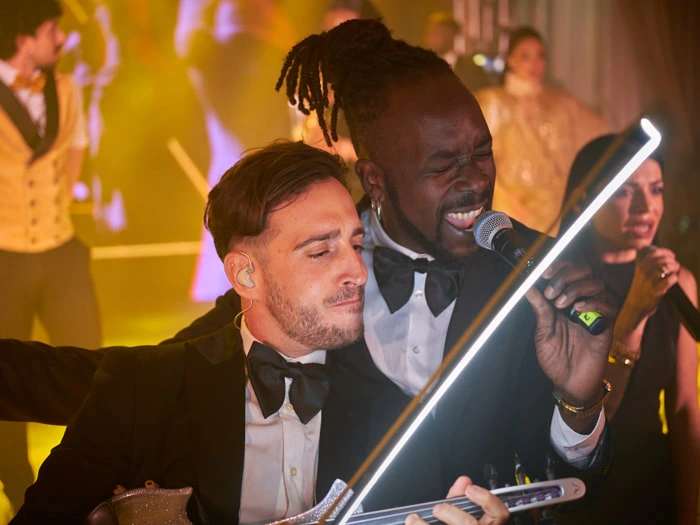 Every moment of the event calls for a different energy
A corporate event unfolds in distinct phases, and each one needs its own soundtrack.
The walk-in, as guests arrive, calls for music that is warm, refined and never intrusive. It should set the mood without drowning out the greetings. During the breaks, between one talk and the next or over the buffet, the music drops in volume and intensity and becomes a thoughtful backdrop that sits under the professional conversations instead of cutting across them. At the closing party, when the goal shifts to letting go, the DJ can finally raise the energy and get the room dancing.
An experienced professional senses these transitions before they become obvious. They read the signals in the room and know when to push and when to hold back. No club DJ is used to handling something this fragmented and this delicate, because in a club the energy climbs in a straight line toward the peak of the night.
Length, repertoire, integration: where the technical differences show
The differences between the two settings also show up in purely technical terms. A club set typically runs for several hours straight, with a musical progression designed to carry the floor without narrative breaks. A corporate event works on a different clock: the DJ may play on and off across an entire day, with long pauses during the speeches and coming back in at exactly the right moments.
The repertoire changes just as sharply. Clubs are dominated by contemporary electronic music, aimed at a crowd that knows and seeks out that specific genre. A corporate setting calls instead for a wide-ranging catalog: timeless classics, recognizable international tracks, the occasional turn toward Italian music when the room asks for it, and constant care to avoid lyrics or sounds that would land badly in front of clients or executives.
Then there is the question of fitting in with everything else on stage. In a club, the DJ is usually the main attraction of the night. At a corporate event, the DJ becomes one piece of a larger production that includes speeches, corporate videos, product reveals and live sets. They have to come in and out of those moments precisely, following the timecode and the technical cues worked out in advance with whoever is directing the event.
Read also: Hard Rock Hotel chooses Mikevents for the opening of its new Malta hub
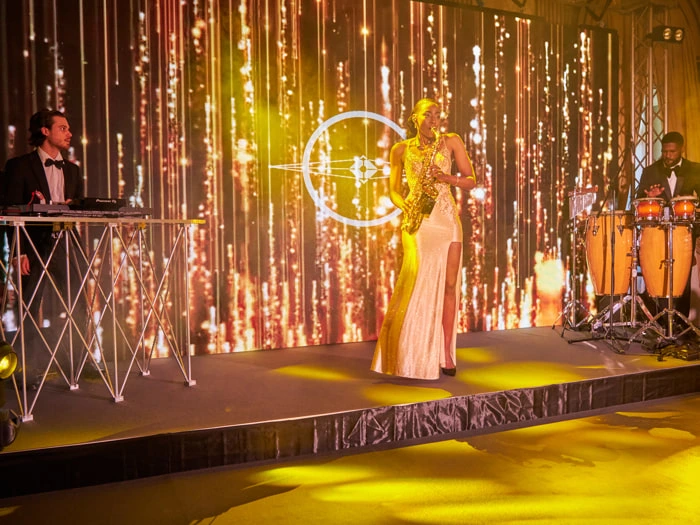 How to choose the right DJ for your convention
Choosing the right DJ for a corporate event means looking for someone who can read the room before reading the playlist. It takes experience with mixed audiences, judgment in measuring out the energy, deep knowledge of genres and decades, and above all the ability to work as part of a team with technicians, show directors and planners without ever losing sight of what the event is for.
Mikevents works on exactly that principle: “When the brand speaks, the music answers.”
For conventions, galas and product launches we design music programs that respect the tone of voice and the KPIs of the event, from pacing to the handling of key messages to the kind of audience in the room. Walk-in, transitions and walk-out are built to match the content of the event, while speeches, videos and reveals are orchestrated with precise timecode and a dedicated technical team.
For brand experiences, Mikevents offers proprietary formats and a sound identity created specifically for each company, so that the music becomes part of how the brand tells its story and not just generic accompaniment to the evening.
Your next event deserves the right soundtrack.
If you are planning a convention, a gala or a product launch, the choice of DJ matters as much as the catering or the venue. Get in touch and tell us about your event: together we will build a music program tailored to your brand and your audience.
Corporate event DJs and club DJs: frequently asked questions
What is the difference between a corporate event DJ and a club DJ?
A club DJ builds a musical progression designed for a floor that wants to dance, while a corporate event DJ has to adapt to a mixed audience and to the different phases of the event. They have to adjust repertoire, pace and volume to the setting, moving from the walk-in through the breaks to the closing party.
What repertoire should a corporate event DJ have?
A corporate event DJ needs a broad, versatile repertoire that can include timeless classics, recognizable international tracks, contemporary pop hits, eighties favorites, Italian music when the room asks for it and instrumental background pieces. The selection always has to suit the professional setting and the audience in the room.
How does a DJ handle the music during a corporate event?
The DJ has to adapt the music to the different moments of the event. During the walk-in they create a welcoming atmosphere without drowning out conversation, during the breaks they lower volume and intensity, and at the closing party they can raise the energy. They also have to stay coordinated with speeches, corporate videos, product reveals and live performances, following the timecode and the technical cues.