


Takeaways
- At the ceremony, a string quartet’s job is mostly about timing: it fills the wait as guests arrive, plays the processional all the way to the altar and closes with the couple’s recessional. What counts, then, is the musicians’ ability to follow what is happening, with pieces arranged to stop at exactly the right point.
- In a church ceremony, the liturgy determines where instruments play: the processional, the offertory, the signing and the recessional, while the responsorial psalm should be sung. Guidelines vary from diocese to diocese, and the music is agreed upon with the parish priest before the wedding.
- A civil ceremony is shorter and leaves more freedom in choosing the pieces; the music centers on the processional, readings or dedications, the signing and the recessional. Either way, the setlist is finalized with the musicians, and the processional route is rehearsed at the venue ahead of the wedding day.
The prelude, the processional, the rite and the recessional each have their own timing, and a string quartet that can follow them keeps the ceremony flowing naturally
At a ceremony, a string quartet almost always plays while someone is walking: guests making their way to their seats, the bride coming down the aisle, the witnesses heading to the signing table, the newlyweds leaving. None of these walks has a length written into the score, yet the music has to begin and end with each one.
That is why, when you choose a quartet for your ceremony, the first thing to look at is how the musicians handle time. Above a certain level, every quartet plays well, but ending a piece at precisely the right moment is a skill that comes only after many ceremonies.
From the guests’ arrival to the couple’s exit, there are four musical moments, and each one has its own timing to manage.
Read also: Choosing your wedding music starts with what you want to avoid
The prelude, before the processional
The quartet starts playing as the first guests arrive, and no one knows exactly how much time will pass between then and the processional: the photos run long, a car gets stuck in traffic, the officiant waits for a relative. The prelude repertoire therefore has to stretch or shrink without the guests, already seated and listening, noticing.
For this part of the ceremony, the pieces are chosen for a consistent character and a gentle volume, so that friends seeing each other for the first time in years can talk quietly, and so that the music can come to a close at the end of any phrase. An experienced quartet arrives with far more music than it will play, because that margin is what keeps a delay from filling up with silence, and a deep reserve repertoire is one of the surest signs of a seasoned ensemble.
The end of the prelude is the music director’s call. Whoever handles the musical direction stays in touch with the person escorting the bride and gives the musicians their cue the instant the door opens, so the music changes on her very first step.
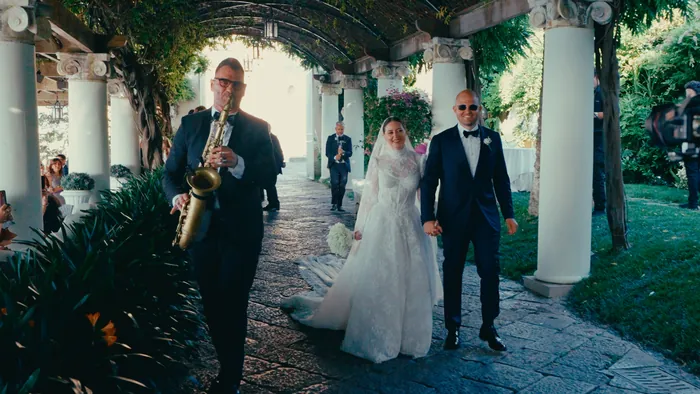 The processional, measured in steps
The processional is the moment the whole room turns toward the door, and the music played for it stays tied to that image in the memory of everyone who was there. It lasts as long as the bride’s walk, or the couple’s walk together, to the altar or the officiant’s table, and the music has to fill exactly that time. A piece that ends halfway down the aisle leaves the bride walking in silence, while one that keeps going after she has arrived makes everyone wait for it to finish, with the couple standing still.
The most experienced quartets solve the problem with arrangements that allow for several possible endings, so the first violin can lead the others into the finale as soon as the bride reaches her place. To pull this off, the musicians need to see the door and the entire route, so where they sit is planned together with the seating layout. In the days beforehand, whoever is directing the music walks the route at the venue and times it, because the aisle of a basilica and the garden path of a villa take very different amounts of time, and the piece has to be chosen, or cut, to fit.
In church, the rite sets the timing
In a church wedding, the music follows the liturgy, and the quartet plays only at the points where the celebration allows for it. The Rite of Marriage published by the Italian Bishops’ Conference calls for songs “suited to the rite of Marriage” and gives special weight to the responsorial psalm, which is meant to be sung. According to the most common diocesan guidelines, instruments have their place mainly at the processional, at the offertory when no hymn is planned, at the signing and at the recessional.
The signing is when the music has the most room, and it is also where the Ave Maria that so many families request usually finds its place, in either the Schubert or the Bach–Gounod setting.
The rules vary from one diocese to the next, though, and often from one parish to the next, so much so that some churches allow only the organ while others gladly welcome strings. Many ask couples to avoid opera, film scores and pop songs during the service; these are better saved for civil ceremonies and the reception. That is why the repertoire is agreed upon with the parish priest well in advance, by providing a list of the pieces, each with the moment it will be played, and the quartet coordinates with the parish organist or choir when there is one.
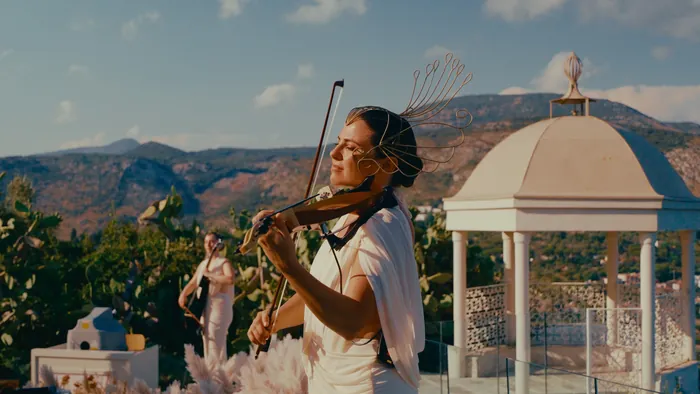 The civil ceremony: shorter and freer
A civil wedding is shorter than a religious one, often around half an hour or even less, and the musical moments come down to the processional, an interlude between readings or dedications, the signing and the recessional. With no liturgical constraints, the repertoire can be truly personal, and a film theme or a song that means something to the couple, arranged for strings, fits in easily.
Constraints, when there are any, have to do with space and timing. A city hall ceremony room may host weddings back to back, so it is worth asking in advance how much time you will have to set up and whether there is room for four seated musicians with music stands.
Outdoors, at a villa or in a garden, acoustics are what matter, because with no walls around them, the sound of the strings disperses. Light, well-placed amplification lets guests in the back rows hear clearly without the volume becoming too loud for those seated up front.
The recessional and the transition to the reception
The recessional is the first celebratory moment of the day, and the quartet can change character with livelier tempos, a piece the guests recognize or an arrangement of a song that is uniquely the couple’s own.
The music often continues as guests file out, greet one another and head to the cocktail hour, and where the venue allows it, the quartet follows them to where drinks are served, becoming the first set of the reception. Yet it is precisely between the ceremony and the cocktail hour that a gap most often opens up, when the strings have packed up and the DJ or band has not started yet. To avoid it, the transition is planned together with the rest of the day.
Read also: DJ or live music? At weddings, the smartest choice is to combine them
The right quartet for your ceremony
For Mikevents, the ceremony is the first phase of a wedding’s music plan. We offer streamlined quartets or soloists, with a contemporary sound and understated arrangements, and a setlist built together with the couple and rehearsed before the wedding day; during the ceremony, we handle the musical direction.
Our advice is to start thinking about it 4–6 months before the wedding, and earlier if you are getting married in peak season, so you have time to choose the pieces and clear them with your officiant.
If you want to find out which ensemble and which pieces suit your ceremony, tell us how you picture it. We will start with the processional route and work our way to all the music for your day.
Ceremony string quartets: frequently asked questions
When does a string quartet play during a church ceremony?
At a church wedding, a string quartet typically plays before the processional, as guests arrive, and then for the processional, the offertory when no hymn is planned, the signing of the register and the recessional. The responsorial psalm, on the other hand, should be sung. The exact moments depend on diocesan guidelines and are agreed upon with the parish priest.
Can a string quartet play any piece in church?
During the service, many dioceses ask couples to avoid opera, film scores and pop songs, and some parishes allow only the organ, so the repertoire should be submitted to the parish priest well in advance. A civil ceremony has no liturgical constraints, and a string quartet can also play arrangements of pop songs or movie themes.
How far in advance should you book a string quartet for the ceremony?
For the most in-demand ensembles, it is best to start 4–6 months before the wedding, and earlier in peak season. Booking early secures the date and leaves time to choose the pieces, agree on the repertoire with the parish priest or officiant and rehearse the processional at the venue.