


Takeaways
- An entertainment idea loses its impact when guests have already seen it at other weddings and recognize it before it even begins. It holds up when it grows out of a specific moment of the day and out of the couple’s story, which no other wedding can repeat.
- Photo booths, surprise performances and dinner shows still work when they are well curated and placed at the right point in the evening. They grow stale when they become just another corner, a telegraphed surprise or a show that interrupts dinner.
- The test that endures is direction, because a few ideas linked to one another and to the timing of the reception leave a sharper memory than a string of unrelated gimmicks. Immersive experiences follow the same rule and succeed when a single theme runs through the entire evening.
Photo booths, surprise performances, dinner shows and immersive experiences hold up as long as they stay connected to the couple and to the moment they appear, and direction determines how long they last
An entertainment idea grows old the moment guests recognize it before it starts. People who attend several weddings in the same summer keep finding the same photo corner, the same surprise entrance, the same light-show finale, and at your party they register them as part of the decor.
Nearly every idea people talk about today can still work, as long as it is created for that particular wedding, because guests cannot have seen an idea tied to the couple and to a specific moment of the day anywhere else. That goes for the photo booth, surprise performances, the dinner show and immersive experiences, and each of these formats has its own way of staying fresh or wearing thin.
Read also: Wedding music and entertainment are two jobs that should not be handled by the same person
Why an entertainment idea grows old
A surprise works once per guest. The first time a guest sees a singer rise from a table and launch into a song, the room turns and someone reaches for a phone; the third time, at three different weddings, the same move is met with a polite smile, because the effect depends entirely on not seeing it coming.
Social media speeds up this wear and tear, since a photogenic idea is shared and copied quickly, and by the time it reaches your party, many guests have already seen it on their screens. The easier an idea is to copy, the faster it grows old, while an idea that depends on people, places and timing that are hard to replicate holds up better.
For the same reason, a list of entertainment options designed to suit any couple comes with ideas that many guests have already encountered, and that will have less impact at your party.
The photo booth, from novelty to fixture
The photo booth is the most obvious example. When it first appeared at weddings, it was a small attraction; today many guests expect it, and anything expected struggles to get noticed.
It still works when it is conceived as part of the decor, with backdrops and lighting in the style of the party, and when it has a set time in the evening, such as the cocktail hour, when guests are moving around and eager to catch up. Placed next to the dance floor, however, it pulls guests away from dancing just when the energy of the evening should be building, which is why whoever directs the evening opens and closes it according to the setlist.
 Surprise performances
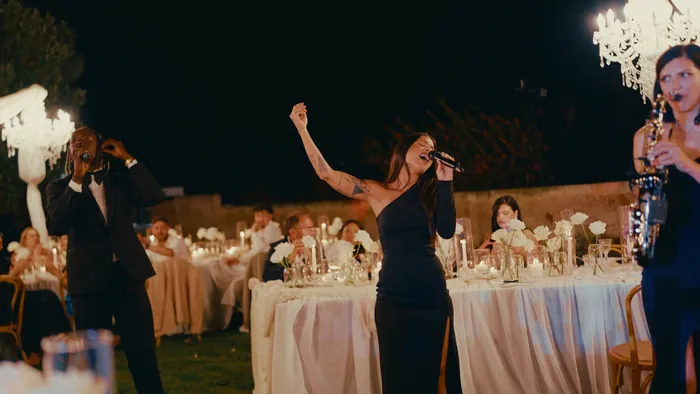
Surprise performances are both the ideas that age the fastest and the ones that can create the most powerful moments. The singer who stands up among the tables, posing as a waiter or a guest, is the best-known example, and for that very reason many guests see it coming from the first notes.
A surprise that works grows out of a moment in the evening and needs no announcement. An electric violin that comes in over the DJ set at the peak of the party works because it arrives when the energy calls for it, and even a voice rising from among the tables can still surprise if it lands at the right moment, for example while dessert is being served. The timing is the director’s call, since the director knows the setlist and reads the room.
Then there is the question of who performs it, because a surprise entrusted to a top-tier artist holds up against everything guests have already seen, while an improvised stunt wears off in seconds.
The dinner show, if it respects the dinner
The dinner show remains the most solid format when it follows the rhythm of the meal. The performance segments work if they fall between courses, synchronized with the service, lighting and effects, and if they leave guests time to eat and talk.
A show that overlaps with the service forces the waitstaff to wait and the guests to choose between their plates and the stage, and the evening ends up feeling fragmented. That is why a dinner show is built together with the front-of-house team, and the kitchen’s timing goes into the run-of-show alongside the artists’, with agreed start and end times for every segment.
 Immersive experiences
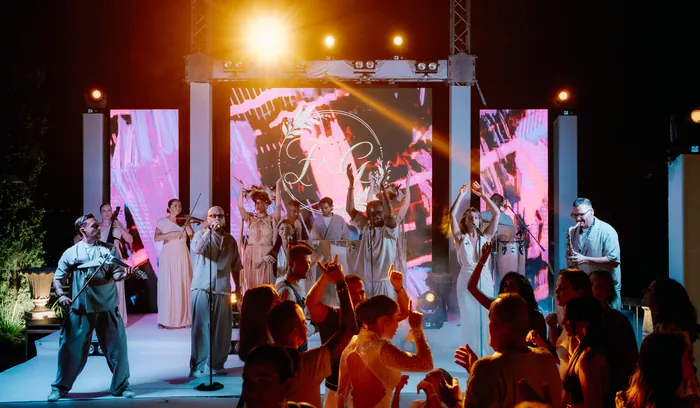
The main risk with immersive experiences, meaning projections, light effects and installations that transform the room, is overload. When every moment of the evening has a different effect, guests stop noticing, while a single idea that runs through the entire party, such as a visual theme or lighting that changes with the music, stays with guests and becomes part of the day’s photographs.
The most successful immersive effect is often the simplest one, too. When lights and music are run by the same direction team and timecode cues them together, the shift from dinner to party becomes a scene change the whole room feels at the same instant, with no need for extra installations.
This matters even more in a historic villa or palazzo, where the spaces already create the atmosphere and the lighting and audio work is there to enhance them without overpowering the architecture.
The test that never gets old
An entertainment idea lasts when it has a reason to be at that wedding, because it recalls the couple’s story, showcases the venue or marks a specific moment of the evening, and when someone controls exactly when it comes in and goes out.
Two or three well-crafted moments, linked to one another, leave a sharper memory than a long string of gimmicks, because direction holds them together in a progression that takes guests from the ceremony to the party.
Read also: An electric violin can change your wedding (for the better)
Entertainment built around your celebration
With Mikevents, entertainment is part of the wedding’s music plan from the start, from the ceremony to the after-party. We choose artists from our roster, including singers, DJs, electric violinists and saxophonists, ensembles and performers, and place them at the moments when they are needed, with staged performances at dinner, synchronized with the courses and the lighting, and a party where the DJ set opens up to live violin or sax. We can also bring the signature formats created by Mike Violinist, the electric violinist with whom Mikevents began.
If you want entertainment your guests have not already seen elsewhere, tell us about your celebration, and we will use that as our starting point to choose a few ideas, the right ones for your wedding music.
Wedding entertainment ideas: frequently asked questions
Which wedding entertainment ideas still work?
Nearly all the popular ideas still work, from the photo booth to the dinner show, when they are tied to the couple and to a specific moment of the day. A surprise performance at the peak of the party, a show synchronized with the courses, a single visual theme for the evening: each holds up better than a host of ideas thrown together without direction.
Is a photo booth still a good idea at a wedding?
A wedding photo booth still works if it is designed as part of the decor, with backdrops and lighting in the style of the party, and if it has a specific slot in the evening, such as the cocktail hour. Placed near the dance floor, however, it can pull guests away from dancing just when the party should be picking up.
How do you keep wedding entertainment from feeling like something guests have seen before?
To keep the entertainment from feeling familiar, choose a few ideas tied to the couple’s story, the venue and the moments of the day, and entrust them to top-tier artists. A director who decides when each act comes in and goes out, based on the setlist and the energy in the room, makes the whole experience cohesive and hard to replicate at any other wedding.