


Takeaways
- Live music elevates the walk-in, the interludes, and the walk-out, turning transitions into moments that prime the audience, hold their attention, and leave a positive emotional close.
- When it comes right before or after a speech, music can reinforce the memory of the key messages, because it ties the spoken content to a more intense, engaging experience.
- To be effective, the music has to be designed alongside the run of show, respecting timecode, audience, tone of voice, and brand identity, so it builds a coherent narrative across talks, videos, and staged moments.
At the most polished corporate conventions, live music elevates the speeches and the brand identity through a single narrative
Close your eyes and think back to the last corporate convention you attended. What do you actually remember? Probably not the slides, and not the figures rattled off from the stage either.
You remember a feeling, a precise moment when something made you look up from your phone. That moment, more often than not, has a soundtrack.
Live music isn’t merely decorative filler at corporate events: it’s a strategic tool that amplifies the memorability of everything around it, the talks included.
Read also: Wedding music and entertainment are two jobs that should not be handled by the same person
The stage speaks even when no one is speaking
At a well-built corporate event, time is split between speaking moments and transitions. It’s the latter, often underestimated, that define how the audience experiences the entire format. The walk-in, the interludes, and the walk-out are the three points where live music plays its most important part.
The walk-in is the first emotional contact between the audience and the event. It’s the moment when guests enter the room, take their seats, look around, and begin to form an expectation. A live musical backdrop, tuned in tone and volume, signals care and refinement before a single word is spoken. It turns a simple entrance into a sensory experience that primes the audience to listen.
The interludes, the musical moments between one talk and the next, serve an almost neurological function. The human brain struggles to hold attention over long stretches. A well-calibrated musical interlude offers a cognitive pause that lets the audience digest what they’ve just heard and recharge for the next speaker. It’s a breath that, paradoxically, makes everything else in the program resonate more.
The walk-out, the exit, is the last impression the event leaves on its guests. It’s the moment when the energy built up over the day finds its resolution. Well-chosen live music at the close turns the end of the event into a positive memory, the one people will recount to their colleagues the next day.
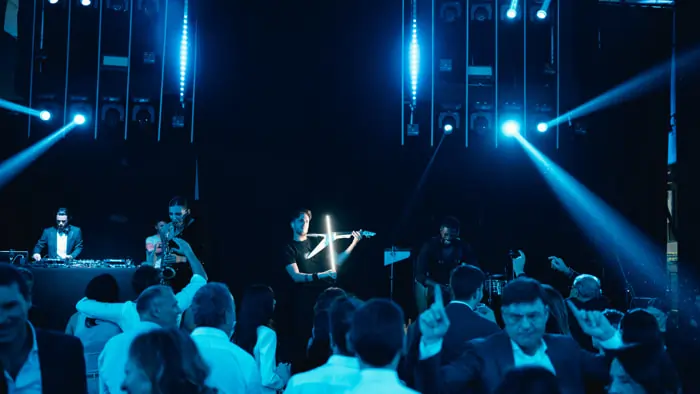 Why can live music make speeches more memorable?
Here’s the crux of it: live music doesn’t compete with the talks, it strengthens them. When a speaker takes the stage after a well-orchestrated musical interlude, the audience arrives already in an emotional state that’s open to listening. Attention is higher, the audience is more receptive, and the message that follows is felt more strongly.
Research on emotional memory confirms a simple principle: we remember better what is tied to a strong emotion. Live music triggers measurable physiological responses, from a rise in heart rate to the release of dopamine, which translate into a more engaging and therefore more memorable experience.
If a speech is preceded or followed by a well-calibrated musical moment, that emotion attaches itself to the spoken content. The result is that people remember not only the feeling but also the key ideas expressed by whoever was speaking.
This effect has a direct bearing on the event’s emotional KPIs: the perceived level of engagement, the willingness to share content on social media, the recall rate of the main message in the days that follow. These are less immediate metrics than attendance figures, but they’re the ones that determine whether an event truly met its strategic goal or remained a plain sequence of slides.
Music works when it’s built into the event
For live music to truly work, it has to be conceived alongside the rest of the run of show, not tacked on at the last minute. The musical timing has to speak to the event’s timecode, the genre and intensity have to respect the brand’s tone of voice, and every transition between a spoken moment and a musical one calls for precise technical direction.
A brand that communicates innovation and speed will need a different sound from one built on elegance and heritage. The alignment between music and brand identity is what turns a good musical moment into a coherent, recognizable brand experience.
The audience matters too. A gala aimed at top management calls for different musical choices than a convention involving hundreds of employees of varying ages and expectations. To be effective, live music has to speak the language of those listening, without ever drowning out the event’s central message.
Read also: The wedding reception playlist is written with the floor plan of the room in front of you
The added value of a format tailored to your brand
Designing an event where music and words speak to each other takes technical and artistic skills that go beyond simply selecting a repertoire. It takes direction that can orchestrate speeches, videos, and reveals into a single narrative flow, with precise control of timing and stage delivery. It also takes the ability to build a sound identity aligned with the brand, one that sets an event apart from every other event the attendees have attended.
This is exactly the approach Mikevents brings to conventions, galas, and product launches: run-of-show plans built around timing, message, and audience, with speeches, videos, and reveals orchestrated through timecode and technical direction. Confidentiality and brand safety are standard practice, and every brand experience grows from proprietary formats and a bespoke sound identity, designed to make each talk more memorable.
If you’re planning your next corporate event and want every talk to stay with your audience, get in touch and tell us about your project. Mikevents can build the right sonic program with you to turn your convention, gala, or product launch into an experience people will remember for a long time.
Live music for corporate events: frequently asked questions
Why does live music make corporate talks more memorable?
Live music creates an emotional engagement that can strengthen attention and the recall of content. When a speech is preceded or followed by a well-calibrated musical moment, the emotion the music generates attaches to the ideas the speaker expresses, helping the audience remember the message better.
What is the role of music during the walk-in, the interludes, and the walk-out?
During the walk-in, music welcomes guests and primes them to listen. In the interludes, it offers a cognitive pause between one talk and the next, while at the walk-out it accompanies the close of the event and helps leave the audience with a positive final impression.
How does live music fit into a brand’s identity?
The music has to be designed alongside the run of show, respecting the brand’s tone of voice, the makeup of the audience, the timecode, and the different moments of the event. Genre, intensity, and musical transitions have to support the speeches, videos, and reveals, building a coherent, recognizable sonic narrative.