


Takeaways
- Villas, centuries-old palaces, cloisters and Roman terraces are not simply a scenic backdrop: they directly shape the acoustics, the sound intensity and the emotional atmosphere of the event. Effective music comes from the ability to read these spaces, understanding their architectural features and how they carry sound, so as to create a harmonious dialogue between the performance and its setting.
- Roman weddings, often international, call for a musical selection that can speak to different audiences without feeling artificial or clichéd. Building the repertoire becomes a storytelling process, in which Italian tradition, international standards and songs meaningful to the couple are balanced with care, favoring coherence and interpretive quality over mere variety.
- The success of a wedding in a historic Roman residence depends on the ability to adapt the performance to the timing of the reception and to the venue’s sonic particularities. An experienced musician knows how to build a finely tuned emotional arc, measuring out energy, repertoire and volume so that every moment leaves guests with an intense, immersive and memorable impression.
Rome’s historic venues shape the acoustics, the repertoire and the atmosphere, making music an integral part of the wedding experience
There is a moment, during a Roman wedding, when everything stops. Not because of a hitch, not because of a distraction: it stops because the beauty all around is so dense that your breath catches on its own.
A loggia overlooking the Forum, a hall with seventeenth-century frescoes, an Italian garden where the cypresses stand like silent guardians of centuries of history. Rome does not simply host weddings: it transforms them.
And the music, in this context, cannot help but transform along with them.
A stage that already has its own voice
Choosing Rome for your wedding means accepting an implicit pact with history.
The historic villas and palaces that frame ceremonies and receptions are not neutral spaces: they have a personality, an acoustic, an atmosphere shaped over centuries. The music that plays within those walls cannot ignore all this. It has to converse with it, respect it, elevate it.
Anyone who works professionally in the world of Roman weddings knows it well: every venue calls for its own sonic thinking. A Baroque courtyard returns sound differently from a frescoed hall on the piano nobile. A terrace overlooking the city’s rooftops asks for something completely different from a secluded garden within the Aurelian Walls.
The first question to ask yourself, even before thinking about the repertoire, is: which space do I need to make sing?
The repertoire as an act of cultural mediation
Weddings in Rome have a trait that sets them apart from those in many other Italian cities: they are often international. American, British, French, German and Australian couples choose Rome as the destination for their wedding, and with them come families, friends and very different musical expectations. The musician or band called on to play thus ends up acting as a genuine cultural mediator.
A repertoire designed for a mixed audience is not simply an eclectic playlist: it is a coherent narrative that manages to be understandable and engaging for people raised on wildly different musical references. Great Italian music, from Puccini to the classics of Neapolitan song, from Morricone to the pieces the whole world associates with Italy, works across the board, because for foreign guests it is an integral part of the experience they came looking for. But it only works if it doesn’t turn into a musical tourist brochure: it has to be performed with intention, with care, with the awareness that you are telling something true.
At the same time, a well-chosen jazz number, an American standard sung with taste, a song the couple has named as “our song”, whatever its origin, all find their natural place when woven intelligently into a broader narrative thread. The key is never accumulation, but selection.
Time as a precious resource, not a limit
One of the aspects that most defines weddings in Rome’s grand historic residences is the time structure of the reception. Prestigious venues operate with great professionalism and organization: the timings are agreed carefully at the contract stage, and the evening’s program follows a precise rhythm, calibrated to ensure the quality of the overall experience. This naturally includes the music as well.
For an experienced musician, working within a defined time frame is simply part of the grammar of the craft. In fact, it is one of the conditions that makes truly good work possible. Knowing exactly how many hours you have, and at which point in the evening, lets you build a musical journey with a beginning, a middle and an end. It lets you measure out the energy, create anticipation, and lead guests toward the highlights without rushing.
The wedding-music professionals who regularly work with Rome’s great venues have developed over time a specific sensitivity to this aspect. They know how to build a set that, in the time available, still leaves guests feeling they have experienced something complete, intense and memorable.
 The acoustics of the centuries
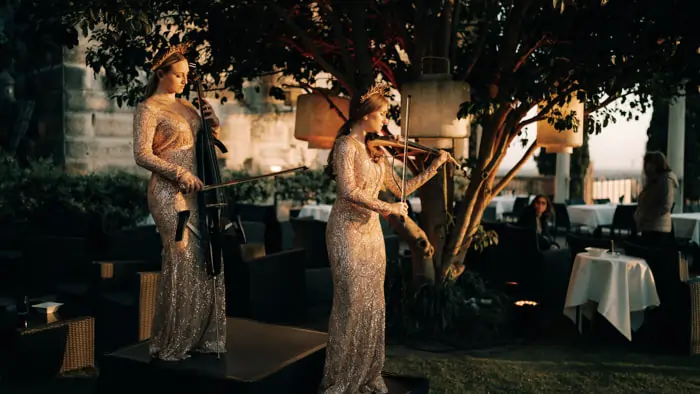
There is a technical element that is often underestimated when choosing music for a wedding in a historic venue: the acoustics. Roman palaces were not built with twenty-first-century sound systems in mind. The high vaults, the marble or stone surfaces, the great frescoes covering walls and ceilings create complex sound environments, where sound reflections can become a problem or an extraordinary asset.
A string quartet in a frescoed hall can produce a sound of a richness almost impossible to achieve in any other setting. A single voice with guitar in a cloister at sunset takes on a depth and resonance that no modern concert hall could replicate. But the same environment can turn into a minefield for anyone who doesn’t know its characteristics: volumes that are too high, the wrong frequencies, careless placement can ruin an atmosphere built with great care.
This is why the choice of musical ensemble must be considered together with the venue, not separately.
Rome as a frame, not a backdrop
The conclusion, if there is one, is this: getting married in Rome in a historic villa or palace is already a meaningful choice in itself. It is far more than a merely aesthetic matter: it is a statement about how you want that day to be remembered. The music, in this context, has the responsibility of living up to that choice.
Living up to it, though, does not mean pompous, does not mean formal, does not necessarily mean classical in the strict sense. It means aware. Aware of the space it plays in, of the audience listening, of the moment it accompanies, of the time it has. Music, in other words, that knows it is in Rome and knows what that means.
Because Rome is not a backdrop. It is a character. And like any self-respecting character, it deserves counterparts worthy of it.
Your day (with the right music)
If you are imagining your wedding in Rome and feel that the music must be something more than a detail, something that gets into the marrow of that day and never leaves, then you already know you can’t leave it to chance.
Mikevents was born for exactly this. Behind every project is the artistic vision of Mike Violinist and a team that has turned listening, precision and reliability into a concrete promise: what you imagine must match what happens on stage. We work all over the world with a curated roster and an approach that leaves nothing to chance, because a wedding in Rome, among villas and palaces that carry centuries on their shoulders, does not allow for it.
Tell us your vision without hesitation. Together we will build the tailor-made sound experience for you: write to us today.
Getting married in Rome with the right music: frequently asked questions
Why is the choice of music so important at a wedding in Rome?
In a city like Rome, where many ceremonies take place in historic villas and centuries-old palaces, music becomes an integral part of the wedding experience. The acoustics of the spaces, the architectural context and the venue’s atmosphere directly influence the type of musical ensemble and the most suitable repertoire.
Which repertoire works best at an international wedding in Rome?
At international weddings it is important to build a balanced repertoire that can engage guests from different cultures. Italian music, from the great classics to the most recognizable film scores, can sit alongside jazz standards, international songs and pieces meaningful to the couple, as long as everything is woven into a coherent musical narrative.
How do the acoustics of a historic venue affect the wedding music?
Rome’s historic venues have very particular acoustic characteristics due to high ceilings, marble surfaces, frescoes and large open spaces. A well-chosen musical ensemble can make the most of these features, while unsuitable volumes or instruments risk compromising the atmosphere of the event.