


Takeaways
- Poorly managed volume can compromise the atmosphere even before guests turn their attention to the music. When the sound comes from just a few points and in an uneven way, some guests find it intrusive, while others barely perceive the background music. This imbalance leads to louder conversations and a widespread sense that something is off.
- Placing speakers strategically across different areas of the venue makes it possible to create even coverage, avoiding excessive volume near the speakers and almost silent zones in the more distant spots. The result is a more elegant and relaxed setting, where the music supports the evening without demanding attention and conversations can flow naturally.
- Each phase of the event – from the ceremony to the dinner and the final party – has different acoustic needs. A professional sound service must design listening points, adapt the system to the layout of the venue and modulate the volume following the emotional rhythm of the day, alternating moments of musical prominence with spaces dedicated to conversation without ever breaking the harmony of the experience.
Sound distribution, listening points and calibrated volumes make the difference between an elegant background and a space that feels off
Few details separate a carefully planned wedding from one thrown together in a rush, and almost no one notices them: one of these is the way the sound reaches the guests’ ears. From the very first minutes, this detail determines whether the atmosphere works or whether something feels off, even when the musical repertoire is impeccable.
Think of a wedding dinner. Guests are seated at their tables, conversations flow, toasts alternate with laughter. If the music comes from a single point, perhaps two large speakers placed on either side of the room, those near the speakers find the volume overwhelming, while those seated at the far ends of the room can barely hear a thing.
The result is an imbalance that forces people to raise their voices to be heard, creating a general hubbub that drowns out the very music meant to accompany the evening. It’s a subtle glitch, but a noticeable one.
Read also: Choosing your wedding music starts with what you want to avoid
Quadraphonic sound: the art of distributing audio
The solution to this problem has a technical name: quadraphonic sound.
The underlying concept is simple and intuitive. Instead of concentrating the audio in two or three points, smaller speakers are distributed across different areas of the room, creating uniform coverage. Every table receives a balanced amount of sound, with no peaks near the speakers and no gaps far from them.
The main advantage concerns precisely the quality of the acoustic experience for those seated. The music becomes a presence that accompanies the dinner, a blanket of sound that enriches the atmosphere without imposing itself. Guests can converse at a normal volume, without the urge to raise their voices, and this creates a relaxed and refined ambiance, where every element seems to be in its place.
Anyone who has been organizing events for years knows that this choice requires careful planning.
You need to know the layout of the room, understand where the tables are, and assess the surface materials that can absorb or reflect sound. It’s not a one-size-fits-all job: every venue has its own characteristics, and the job of the sound engineers lies precisely in adapting the setup to that specific context.
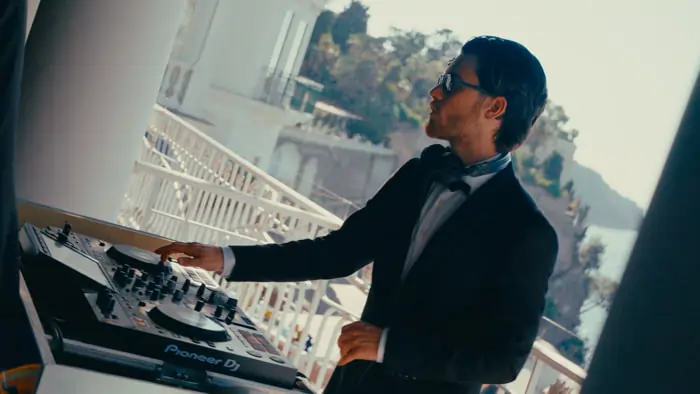 Listening points and the balance between spaces
Another key aspect concerns the distribution of listening points during the various phases of the day. A wedding is anything but a static event: it unfolds through very different moments, each with its own acoustic needs. The ceremony calls for particular attention, because the sound must clearly reach everyone present, even those farthest from the point where the musicians are performing.
The cocktail hour, on the other hand, needs background music that encourages conversation without overpowering it. The dinner calls for the balanced distribution we mentioned, while the party, as the dance floor comes alive, can finally allow itself higher volumes and a different kind of energy.
Thinking about listening points therefore means planning in advance how the sound will move through the space over the entire day, anticipating the changes of scene and preparing the system to follow this progression. It is not about switching on a setup and leaving it fixed for hours, but about approaching sound design as a dynamic element that changes along with the rhythm of the celebration.
Volume modulation: the art of not drowning things out
There is then a third element, perhaps the most subtle of all, which concerns the modulation of volume over time. During a dinner show, for example, there are moments when the music takes center stage, perhaps accompanying the arrival of a special course or a stage effect designed down to the smallest detail. At those moments the volume can rise, capture attention, become part of the show. But immediately afterward, when the room returns to conversation, the volume must come down just as naturally, leaving room for voices and toasts.
This ability to modulate, to raise and lower the volume following the emotional flow of the evening, requires sensitivity and constant attention. Whoever manages the audio during a wedding must read the room in real time, sensing when guests want to talk and when, instead, they are ready to be swept up by a more intense musical moment. It is a balance built through experience, by observing people’s reactions and stepping in with discretion, without anyone truly noticing.
Read also: Wedding music and entertainment are two jobs that should not be handled by the same person
The difference is felt even before the music
All this work happens even before there is any talk of repertoire, of chosen songs, of arrangements. It is a matter of designing sound within a space, of technique at the service of the experience. And precisely for this reason it is the difference perceived first, even if unconsciously: a guest who feels at ease during dinner, who can talk without effort and who perceives the music as an elegant and never intrusive presence, is experiencing the effects of carefully designed audio.
An elegant wedding, after all, is recognized also by these details that no one notices explicitly but that everyone perceives. It is the difference between an event that flows naturally and one that, however carefully curated in its content, leaves the nagging sense that something is off.
If you are imagining your wedding day and want every moment, from the ceremony to the after party, to have its perfect sonic balance, know that we at Mikevents design exactly this: a tailor-made musical narrative, where elegance, warmth and energy alternate following the natural rhythm of your story. Write to us now and tell us how you picture your day: together we will work out how to make it sound just right.
Wedding music volume: frequently asked questions
Why is the volume of the music so important during a wedding?
The volume of the music directly affects guests’ comfort and the quality of the atmosphere. If the sound is too loud in some areas and too weak in others, guests tend to raise their voices to converse, creating confusion and reducing the effect of the music itself. A balanced management of the volume, by contrast, allows every moment of the day to be accompanied in an elegant and natural way.
What is quadraphonic sound at a wedding?
Quadraphonic sound is an audio distribution system that uses several speakers placed in different areas of the venue to ensure uniform sound coverage. This avoids overly noisy areas near the speakers and almost silent spots far from the system, allowing guests to listen to the music and converse comfortably.
Does the volume of the music change during the different phases of the wedding?
Yes, a well-managed wedding sound setup involves constantly modulating the volume according to the moments of the day. During the ceremony the sound must be clear and well distributed; at the cocktail hour and dinner it must accompany without drowning out conversation; while during the final party it can increase in intensity to engage guests and sustain the energy of the dance floor.