


Takeaways
- Couples who already have a wedding planner also need a music planner when the wedding music becomes a project in its own right, with different artists for the ceremony, cocktail hour, dinner and party. The wedding planner coordinates the day and the vendors; the music planner chooses the artists, writes the setlist and directs it during the celebration.
- The wedding planner manages the day’s timing, and the music planner manages the stage and the sound. Their responsibilities overlap at the site visit, on the timeline the setlist is built on, and during the celebration. At each of these points, a decision by one shifts something in the other’s work.
- On the wedding day, the planner sets the schedule and the music planner turns it into cues for the artists, the sound engineer and the lighting crew. When the schedule slips, the planner makes up the time and the music fills the wait, as long as the division of roles has been clear since the first meeting.
Couples who already have a wedding planner bring in a music planner when the music becomes a project in its own right, and from then on the two divide the day between its schedule and the stage
“I already have a wedding planner. Do I need a music planner too?” Many couples ask themselves this as their wedding starts to take shape, and the answer depends on how much of the day the music takes up. A DJ for the party fits easily within the planner’s coordination. But when a couple envisions a quartet at the ceremony, an acoustic set during cocktail hour, a dinner show and a party with a DJ and sax, the music becomes a project in its own right, one that calls for someone dedicated to the artists, the setlist and the rehearsals.
In that case, the two professionals work on the same wedding from two sides. The wedding planner is responsible for the timing of the day, covering the schedule, the vendors and the guests’ movements; the music planner, for the stage and the sound. For months, the two sit in the same meetings with different documents in hand.
Their responsibilities meet at the site visit, on the timeline and during the celebration, and those are the points that reveal whether your music needs one more person.
Read also: A wedding music planner also decides when there is no music
How they divide the work
The wedding planner oversees the entire wedding, from the venue to the budget and from the guest list to the timeline, which schedules every step, from the arrival at the church to the cake cutting. During the celebration, the planner is the person all the vendors report to.
The music planner takes on the part of all this that guests hear, and oversees it from the choice of artists through rehearsals to the cues on the night of the wedding. Where the timeline reads “9:30 p.m., first dance,” the setlist specifies which version of the song, who plays it, with what lighting and who gives the cue.
The two documents move forward in step, since every entry in the setlist depends on a time on the timeline. Even before either one exists, though, the planner and the music planner meet at the venue, and the first point where their work overlaps is the site visit.
The first meeting is the site visit
At the venue site visit, the wedding planner and the music planner work side by side, floor plan in hand. The planner focuses on the table layout, the guests’ path and the catering routes; the music planner looks at the same square footage and asks where the stage should go so the music reaches everyone without drowning out conversation.
That floor plan leads to decisions that affect both of their jobs, which is why they are made together. The stage has to stay clear of the servers’ path, the speakers are angled away from the couple’s table, and the power supply has to handle a DJ set as well as the band.
The same visit is also when they check the music hours set out in the venue contract, including the time the music has to stop. The music planner builds the party’s progression around those hours, so that the most anticipated song lands before the agreed curfew.
 The timeline and the setlist
The wedding planner’s timeline divides the day into time slots, and the music planner’s setlist is built on top of that grid. Every moment on the timeline, from the processional to cocktail hour and from dinner to the party, becomes a sequence of cues in the setlist: precise signals that tell an artist when to start, when to bring the volume down and when to yield the floor.
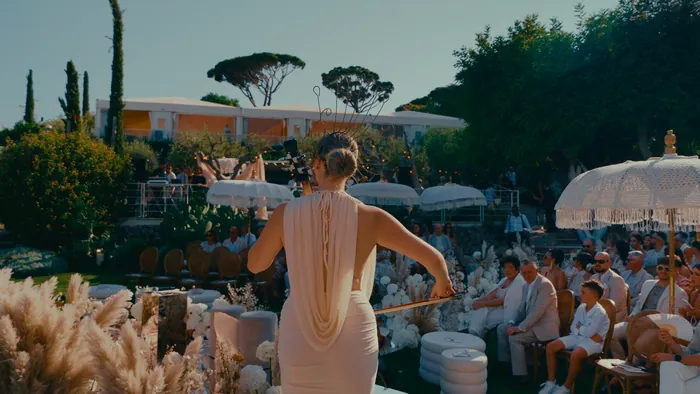
One of the transitions that calls for the closest coordination is the one between the ceremony and cocktail hour. The couple slips away with the photographer, the guests move toward the garden or the terrace, and the timeline sets how long that absence will last. To fill that window, the music planner builds an acoustic set at conversation volume, which welcomes the guests and wraps up when the planner signals that the couple is on the way back.
The timeline and the setlist go back and forth between desks several times before the wedding, and every change to the schedule shifts a few cues. That is why every new version of the timeline has to reach the music planner, even when it only moves the cake cutting ten minutes earlier or later.
 Who gives the cue on the wedding day
On the wedding day, the cues start with the wedding planner, who knows when the kitchen is ready, when the guests are seated and when the cake is about to come out, and flow to the music planner, who passes them on to the artists, the sound engineer and the lighting crew.
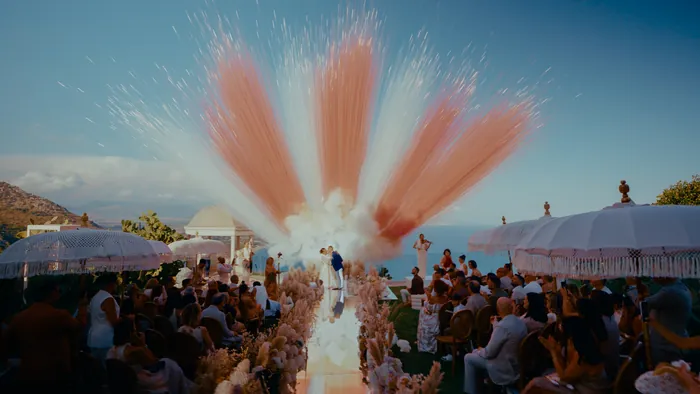
You can see this as early as the end of the ceremony, if a special effect is planned. The planner confirms the couple is in position, the music planner cues the artists, and the technician triggers the effect on the first chord, following a sequence planned on paper and rehearsed on site.
Later, if dinner runs twenty minutes behind, the planner makes up the time by trimming whatever can be trimmed, while the music planner makes sure no one feels the wait by extending the current set or moving a segment. All it takes is for the new time to reach both of them at the same moment.
How to help them work well together
A music planner works best when brought in early, while the timeline is still unwritten. It pays to put the music planner in touch with the wedding planner from the very first meeting and to ask the two to exchange the floor plan, the timeline and the technical rider directly.
That way, the couple discusses the music with just one person and does not have to act as a go-between for two professionals. Questions about the repertoire go to the music planner, questions about the day go to the planner, and each keeps the other informed.
Settle early, too, who has the final say when there is no time to decide together; usually the planner decides on timing, and the music planner on what happens on stage. If that division is in writing before the wedding, neither one has to wonder whose call it is once the celebration is underway.
Read also: The wedding reception playlist is written with the floor plan of the room in front of you
If you already have a wedding planner
A music planner is worth having even if you already have a wedding planner when, at those three points, the music needs more attention than overall coordination can give it. It starts at the site visit, if one room has to provide space and power for both a band and a DJ set; it continues on the timeline, when every new version means rewriting the cues in the setlist; and it carries through to the celebration, where a special effect has to go off on the first chord. In all three cases, the planner stays in charge of the day, and the music gets someone who is responsible for it alone.
That is the work we do at Mikevents, where we handle only the musical, artistic and technical side of the wedding, alongside the planner the couple has chosen. We start with a briefing on goals, budget and venue, write the setlist and the technical rider based on the planner’s timeline and, during production, coordinate with catering, lighting and security, with a plan B ready for every step.
Our proposals for the ceremony, cocktail hour, dinner and party are on our music for exclusive weddings page. If this is the kind of music you have in mind, introduce us to your wedding planner, and we will sit down to that first meeting together.
Music planner vs. wedding planner: frequently asked questions
What is the difference between a music planner and a wedding planner?
A wedding planner organizes the wedding as a whole, from choosing the venue and vendors to the budget, the guests and the timeline of the day. A music planner handles only the musical and artistic side: the artists, the setlist, the technical rider, rehearsals and directing the music during the celebration. The two work together, and the setlist is built on the planner’s timeline.
Do you need a music planner if you already have a wedding planner?
You need one when the wedding music is a complex project, with different artists for the ceremony, cocktail hour, dinner and party, a dinner show or synchronized effects. The wedding planner coordinates all the vendors, while the music planner chooses the artists, writes the setlist and directs the live music, working from the planner’s timeline.
How do a music planner and a wedding planner work together on the wedding day?
On the wedding day, the wedding planner manages the day’s timing and signals when the kitchen, the photographer and the guests are ready. The music planner receives those cues and passes them on to the artists, the sound engineer and the lighting crew. If the schedule slips, the planner sets the new schedule and the music planner adapts the setlist, extending a set or moving a segment.